Your Hometown Is a Lie: The Delightfully Petty World of Map Traps, Ghost Cities, and Towns With a Population of One
Somewhere outside Arlen, Oregon, there's a road that doesn't exist. Not in a poetic, 'the road not taken' way — it literally does not exist. It was invented by mapmakers, copied by competitors, and eventually swallowed whole by the digital age, where it lives on in GPS systems, misleading delivery drivers to this day.
Welcome to America's favorite weird hobby: inventing places.
The Original Anti-Piracy Software Was a Fake Town
Back when maps were printed on paper and sold for actual money, map publishers had a problem. Anyone could copy their hard work. So they did what any reasonable business would do: they hid fake stuff in their products and waited for thieves to steal it.
A fake street here. A phantom lake there. If a rival map suddenly featured the town of 'Goblu, Ohio' or a non-existent 'Agloe, New York,' you had your thief. It's the cartographic equivalent of hiding a spelling error in a dictionary to catch plagiarists — except dictionary traps don't cause anyone to drive into a swamp.
The best part? Agloe, the most famous paper town of all, became so thoroughly fictionalized that someone eventually built an actual general store at its location. A fake place became real because people believed in it hard enough. If that's not the most American story ever told, it's at least in the top five.
The Vigilantes With a Grudge Against Google
Here's where it gets genuinely unhinged. There are people — real ones, with real hobbies and presumably real families — who spend their free time hunting down fake places on Google Maps.
They call themselves map vigilantes. They comb through user submissions, flag phantom businesses, and wage war against 'gum roads' (you'll know them when you see them). Their sworn enemies include scammers who list fake addresses, SEO goblins who spam maps with duplicate listings, and the ghost of every paper town that ever was.
And honestly? They're heroes. Because the alternative is your pizza getting delivered to a retention pond in suburban Ohio, which — and this is documented — has happened.
Cities That Never Were: America's Great Paper Palaces
Then there's the other flavor of fake place: the planned city that existed entirely as a rendering, a brochure, and a developer's unshakeable optimism.
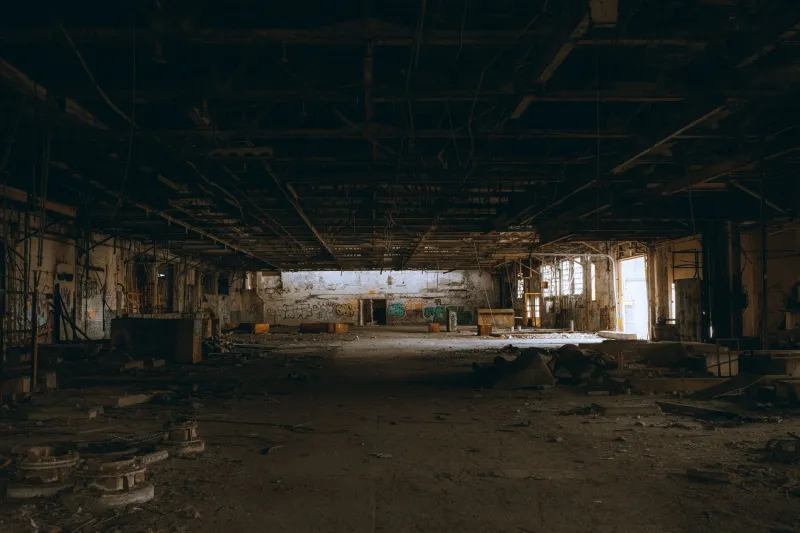
Florida is basically a museum of these. California has a few. Every state has at least one subdivision where the streets were paved, the lots were surveyed, the streetlights were installed — and then the money evaporated and everyone went home. What's left is a neighborhood with infrastructure but no houses. A ghost city with excellent sidewalks.
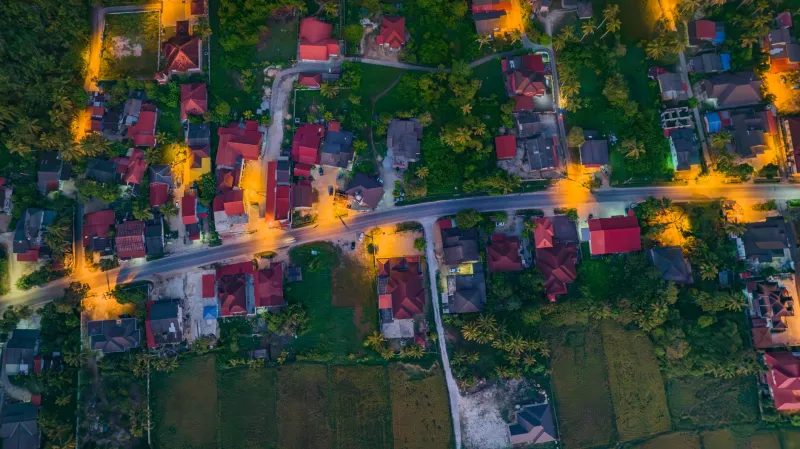
Some of these phantom developments are decades old. The streetlights still flicker on at dusk. For nobody. It's either deeply haunting or the world's most avant-garde art installation, depending on your tolerance for existential dread.
Population: One
And then there's the inverted version of the fake town problem: real places that feel fake because almost nobody lives there.
There are gated communities in the American West with exactly one resident. One. A person who bought into a development promised at 'ten thousand homes' and watched the project die around them, leaving them as the sole citizen of a kingdom of empty cul-de-sacs. They pay HOA dues. They presumably wave at themselves.
There are whole subdivisions where the population has never cracked double digits despite the best efforts of billboards on the interstate. There are towns that legally incorporated as jokes, towns that exist only on zoning paperwork, and towns that exist only because a sign was installed before anyone checked whether the place was real.
Why Do We Keep Doing This?
The pop psychology answer is that humans are natural mythmakers. We name things, we draw borders, we put things on paper, and then the paper becomes more real than the ground it describes. A place on a map has authority. A place on a map gets funding, gets deliveries, gets tourists. Reality is negotiable; cartography is forever.
The slightly less charitable answer is that America was built by people selling futures. Every planned city is a bet that people will come. Most bets pay off — Phoenix exists, against all reason. Some bets don't, and we get a four-lane road to nowhere with a streetlight every fifty feet, illuminating nothing, forever.
Either way, the pattern holds: we invent places, the inventions leak into the real world, and then we hire people to clean up the mess. It's a perfect little loop of American ambition, fraud, belief, and bureaucracy.
Check Your Own Map. We'll Wait.
Go ahead. Zoom into your own neighborhood on your maps app of choice. Check for streets that dead-end into nothing, businesses that are clearly someone's garage, or a lake that is — on closer inspection — a slightly damp field.
There's a decent chance you'll find something. Because in America, the line between a real place and a fake one has always been drawn in pencil. And sometimes, if enough people believe in the pencil, the ink follows.
The town of Agloe would like a word.