Grown Adults Are Playing Tag Now and They Are Completely Serious About It
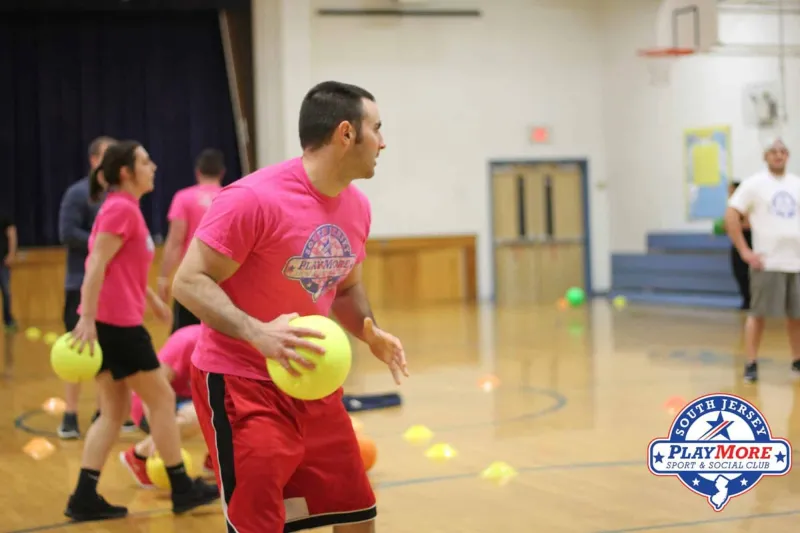
Photo: adults playing dodgeball in gym tournament competitive, via www.playmorenj.com
Let's establish the facts first, because they deserve to be stated plainly: there are regional championships for adult dodgeball. There are tag leagues with official rulebooks. There are grown humans who have purchased specialized footwear for kickball tournaments. There are sponsorships. There are fans. There are people who have practiced their dodgeball throw the way other people practice their golf swing, which is to say, with a level of dedication that would have baffled their elementary school gym teacher.
Welcome to the playground sports revival. It is loud, it is sweaty, and it is absolutely thriving.
From Recess to Revenue
The organized adult recreational sports industry isn't exactly new — softball leagues and bowling nights have existed for generations — but something shifted in the last decade that pushed childhood-specific games into the mix with unexpected velocity. Dodgeball, four square, kickball, capture the flag, and yes, tag, have all developed organized adult competitive circuits with a seriousness that would be easy to mock if the participants didn't seem to be having an absolutely tremendous time.
World Dodgeball Association events now draw competitors from multiple continents. The World Adult Kickball Association (yes, WAKA, which is a perfect acronym) operates leagues in cities across the US with thousands of registered teams. The American Tag Alliance — which, again, is a real organization with a real website — has been working to establish standardized rules for competitive tag, a sentence that probably would have broken the brains of anyone writing about sports in 1987.
The money flowing through this space is legitimately surprising. Registration fees, equipment sales, venue rentals, branded merchandise, and sponsorship deals from companies targeting the exact demographic that shows up to these things — namely, millennials and older Gen Z with disposable income and a complicated relationship with their childhoods — have turned recess nostalgia into a functioning economic ecosystem.
The Nostalgia Mechanism Is Working Exactly As Intended
Asking why adults want to play tag is a little like asking why adults want to eat Lucky Charms. The answer is obvious and slightly embarrassing and also completely valid.
Millennials, currently aged roughly 28 to 43, grew up during a specific window of American childhood that has been extensively mythologized — the era of neighborhood games that ran until the streetlights came on, of gym class dodgeball before liability concerns sanitized it, of recess as a genuine free-for-all. That era is gone in its original form, which means the people who lived it are now in the business of reconstructing it with adult resources.
And adult resources are considerable. You can rent a proper facility. You can buy quality equipment. You can organize a structured league with a Google Form and a group chat. The games of childhood are being rebuilt with the organizational capacity of adulthood, and the result is something that scratches the nostalgia itch while also being a legitimately decent workout.
There's also a fairly straightforward fitness angle here. Dodgeball is genuinely athletic. Tag, at the competitive level, involves sprinting, lateral movement, and spatial strategy. Four square develops hand-eye coordination. These are not trivial physical activities dressed up in silly costumes — they're legitimate athletic endeavors that happen to share DNA with the thing you did at recess in third grade. The fact that they're more fun than running on a treadmill is not incidental to their popularity.
The Vibe Is the Product
Here's what distinguishes the playground sports revival from, say, joining a regular adult soccer league: the atmosphere is the whole point.
Most competitive adult recreational leagues built around childhood games have cultivated a specific energy — one that sits at the intersection of genuine competition and performative absurdity. Teams have ridiculous names. Uniforms are encouraged to be chaotic. Post-game socializing is built into the structure. The whole thing operates with a knowing wink that yes, we are adults playing tag, and yes, we are completely aware of how this looks, and no, we do not care even slightly.
This is a distinct cultural product from traditional adult sports leagues, which tend toward earnestness. The playground revival runs on irony-adjacent sincerity — people who are genuinely competing while also being in on the joke that competition is happening at all. It's a vibe that maps perfectly onto the way millennials and Gen Z have generally learned to hold two contradictory emotional states simultaneously: caring deeply about something while also being capable of laughing at it.
The Serious Business of Not Being Serious
Sponsors have figured this out. Brands targeting 25-to-40-year-olds have discovered that a dodgeball tournament is an extraordinarily efficient delivery mechanism for brand awareness among a demographic that has developed sophisticated immunity to traditional advertising. You can't easily skip the ad when the ad is the event you're currently sweating through.
Local bars, athletic wear companies, energy drink brands, and even some larger national sponsors have started showing up at these events with logos and free samples, understanding that the crowd is primed — physically activated, socially engaged, and in a headspace of openness that most marketing environments fail to create.
The irony is complete: the games invented to give children unstructured free time have been fully restructured, monetized, and incorporated into the attention economy. Recess has been professionalized. The dodge ball has been sponsored.
Is This Fine? (Yes, This Is Fine)
The cynical read on all of this is that it's capitalism colonizing the last innocent corner of human experience. The optimistic read is that a bunch of people found a way to exercise, socialize, and experience uncomplicated joy in an era that offers precious little of any of those things.
SoqDoq is going to go with the optimistic read, mostly because the alternative requires us to be grim about adults having fun, which feels like a losing position.
The playground sports revival is, at its core, a group of people who decided that the best parts of childhood were worth keeping and that adulthood had enough money and organizational capacity to make that happen. The rulebooks are official. The championships are real. The fun is, apparently, very much the point.
Now if someone could please revive competitive four square in the greater New York area, we have a team ready to go.