Paying Good Money to Feel Weird: The Booming Business of Deliberately Bad Comedy
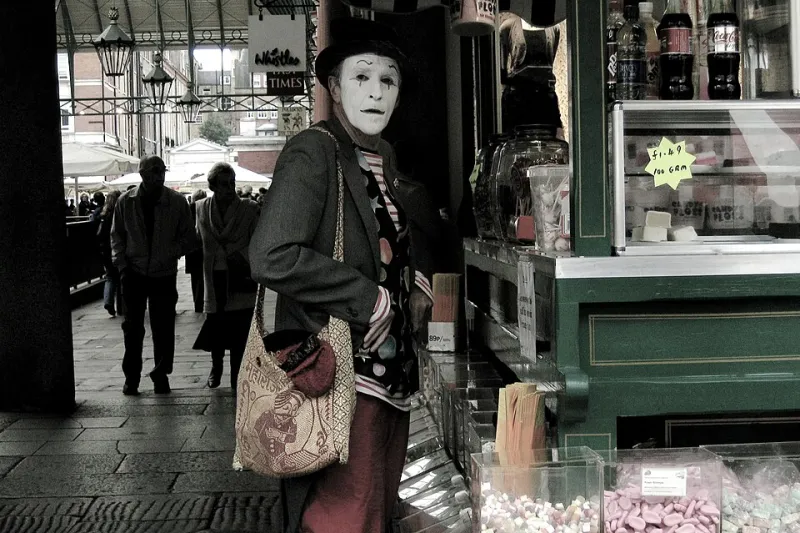
Photo: CGP Grey from London, United Kingdom, CC BY 2.0, via Wikimedia Commons
Let's get one thing straight before we go any further: this is not a joke. Well, technically it is. But also it isn't. And that right there — that maddening little paradox — is exactly why some comedians are currently sitting on piles of money they made by being spectacularly, intentionally, almost aggressively not funny.
Welcome to anti-comedy, the entertainment category that makes your parents genuinely concerned and your algorithm absolutely feral.
The Guy Who Started the Whole Mess
Before TikTok absurdists were racking up millions of followers by staring blankly into a camera for forty-five seconds while elevator music plays, there was Andy Kaufman. If you weren't around in the late '70s and early '80s — and statistically, most of you weren't — Kaufman made a career out of confusing, irritating, and outright alienating his audiences. He read The Great Gatsby aloud at stand-up gigs. He wrestled women. He played a character named Tony Clifton who was genuinely horrible to everyone in the room.
Audiences didn't always know whether to laugh, boo, or call someone. That disorientation? That was the product. Kaufman wasn't failing at comedy. He was succeeding at something else entirely — something that didn't have a name yet.
Decades later, we have a name for it, a thriving marketplace for it, and apparently a very robust appetite for it.
The Awkward Economy, Quantified
Here's where things get genuinely weird in a business sense. Anti-comedy isn't just a YouTube rabbit hole anymore. It's a revenue stream with teeth.
Tim Robinson's Netflix show I Think You Should Leave — a masterwork of sustained, weaponized awkwardness — has become one of the platform's most-quoted properties despite (or because of) the fact that nearly every sketch ends before the joke resolves, leaving viewers in a state of low-grade existential distress. Merchandise sells out. Fan conventions happen. People pay real American dollars to attend live shows built around the premise that nothing will be explained and nothing will be comfortable.
On TikTok, creators like Vic Berger and an entire ecosystem of "cursed content" accounts have built massive followings by posting videos that are edited to feel broken, looping at the wrong moment, cutting off mid-sentence, or following a setup with an answer that is technically a response but absolutely not a punchline. Some of these accounts are monetized at rates comparable to traditional comedy channels.
The math here is genuinely baffling until you stop thinking about it in terms of comedy and start thinking about it in terms of experience.
Why Your Brain Is Actually Into This
Here's the pop psychology corner of our little field trip: humans are pattern-completion machines. We hear a setup, we expect a punchline. We see a character walk toward a door, we expect them to open it. When that expectation is denied — when the door just doesn't open and the comedian stares at it for eleven seconds while a laugh track plays from somewhere offscreen — our brains do something interesting.
They go a little haywire. And apparently, going haywire feels good.
There's a concept in humor research called "benign violation theory" — the idea that we laugh when something is simultaneously wrong and safe. Anti-comedy weaponizes this by removing the "benign" resolution while keeping the "violation" front and center. You're left holding the tension with nowhere to put it. And for a generation raised on irony, meme culture, and the general ambient absurdity of existing online, that unresolved tension is kind of... the whole vibe.
Digital-native audiences didn't just grow up with irony. They grew up inside it. Sincerity became the punchline. Earnestness got memed into oblivion. So when a comedian comes along and refuses to give you the satisfying resolution you've been trained to expect, it doesn't feel like failure — it feels like honesty.
The Live Show Paradox
Perhaps the most unhinged data point in this whole story is what's happening in live performance. Anti-comedy shows — events explicitly advertised as uncomfortable, unresolved, and potentially maddening — are selling out theaters across the country. Some touring acts in this space are charging premium ticket prices, roughly equivalent to what you'd pay for a well-known traditional stand-up.
Think about that for a second. People are paying more than fifty bucks, sometimes significantly more, to sit in a room and feel weird.
The explanation that makes the most sense, weirdly, is community. Attending an anti-comedy show is a shared act of opting in to confusion together. It's a signal — "I'm the kind of person who thinks this is interesting" — and in an era where identity is constantly being assembled and broadcast, that signal has real social value. You're not just buying a ticket. You're buying membership in a particular flavor of weird.
The Grift Question (It Has to Be Asked)
Okay, look. Any honest examination of this space has to acknowledge that "anti-comedy" is also, occasionally, a very convenient shield for people who are just... not funny. If your bit doesn't land, you can always claim the discomfort was intentional. The emperor's-new-clothes problem is real, and the genre has its share of performers who are less "subverting expectations" and more "hoping nobody notices."
But here's the thing: audiences are actually pretty good at telling the difference. The anti-comedy that makes money tends to be extraordinarily precise. Tim Robinson's sketches are technically flawless — the awkwardness is engineered, not accidental. The best TikTok absurdists understand editing at a granular level. The discomfort is crafted.
That craft is what separates the people making millions from the people getting politely ratio'd in the comments.
So What Does This Actually Mean
If you zoom out far enough, the rise of anti-comedy as a legitimate, lucrative entertainment category says something interesting about where American culture is right now. Traditional punchline comedy is still huge — don't get it twisted. But alongside it, there's a growing appetite for content that doesn't resolve, doesn't reassure, and doesn't hand you a neat emotional landing.
Maybe that's what honesty looks like in 2025. Maybe it's what entertainment looks like when the audience has seen every formula a thousand times and the only genuinely surprising move left is to refuse to play the game.
Or maybe people just really like feeling weird, and someone finally figured out how to charge for it.
Andy Kaufman, wherever he is, is almost certainly not smiling. That would be too conventional.